Smart sensors: High-tech for urban trees
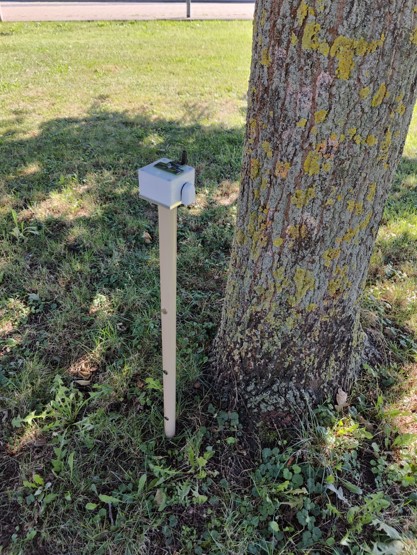
How are our urban trees really doing? To answer this question, we are developing innovative sensors, digital analysis tools, and computer models. These technologies allow us to monitor key environmental conditions and tree health data in real time.
The goal is to detect early signs of stress—such as drought or heat exposure—so that cities can implement targeted, resource-efficient interventions that help maintain the health and ecosystem services of urban trees over the long term.
What is measured?
Our energy-autonomous sensors, some of which are co-managed by local university students, are installed directly on the trees and in the soil. They continuously collect the following data:
✅ Environmental factors: air temperature, humidity, solar radiation, soil water content, soil temperature
✅ Tree reactions: Growth and water deficit (microdendrometry)
The Department of Microsystems Engineering at the University of Freiburg, the Joseph Gottlieb Kölreuter Institute of Plant Sciences (JKIP) at KIT and the Chair of Forest Growth and Dendroecology at the University of Freiburg are cooperating in this sub-project
Results
At the Chair of Microsystems Design at the University of Freiburg, energy-autonomous and wireless soil probes were developed as part of the project, in close collaboration with the Institute for Environmental Research (KIT, Garmisch) and the Chairs of Dendroecology (University of Freiburg) and Molecular Cell Biology (KIT). These probes contain temperature sensors for determining the soil temperature profile, humidity and air temperature sensors, and an optical spectral sensor for measuring photosynthetically active radiation (PAR). A commercial soil moisture sensor can also be connected. A probe-compatible low-power dendrometer was developed as an additional sensor. It measures the daily expansion and contraction of the tree’s diameter as an indicator of its sap flow and transpiration.
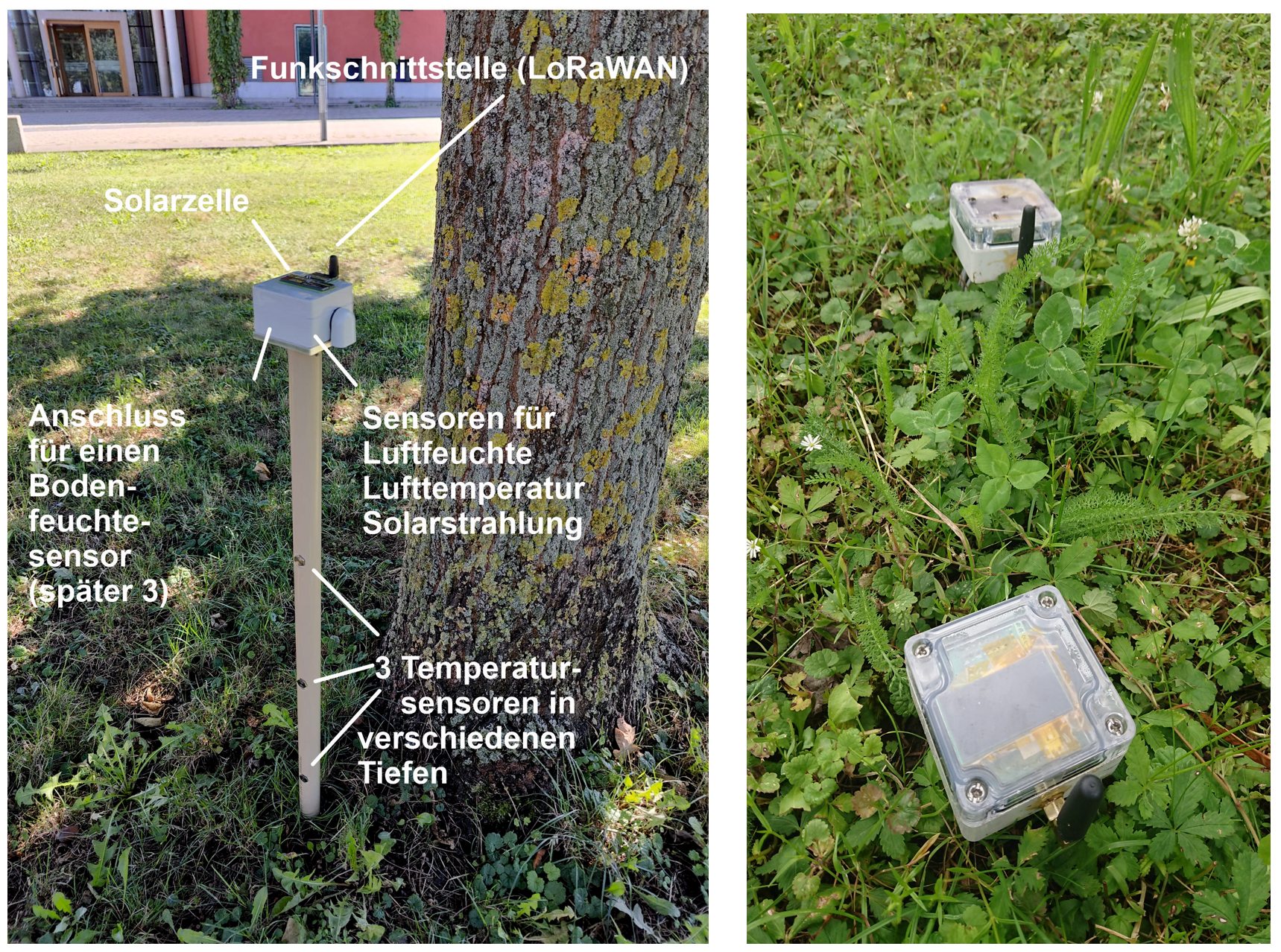
The result is a flexibly configurable, robust, and reliable sensor node that can be used not only in this project but also, for example, in agriculture or general climate research. All sensor nodes are self-powered by a small solar cell and transmit their data using the LoRaWAN wireless standard. Data collection takes place via the so-called “Things-Network,” a provider of cloud data storage for LoRaWAN wireless sensor networks. The corresponding database structure has been established and is available. Open data access, in the sense of citizen participation, is thus fundamentally possible. By the end of the project, 9 soil probes will be deployed on KIT’s South Campus, and another 9 in the city of Freiburg. As a transdisciplinary initiative, a collaboration with the City of Freiburg was launched in this context, with the goal of collecting soil probe data and making it available through the “Datenraum Freiburg” initiative.